AGENDA
- "Faking Nature" (Elliot)
- Report on the dire wolf
- Restoration vs. rewilding
- Treuer, returning the National Parks to the tribes
_________________________
Faking Nature (Elliot)


(A) Do restorations really have all the original features and functions?
(B) The art argument
"Straw man" version
- Nature is like art
- Origns matter when it comes to art (authentic vs. forged). THEREFORE
- Origins matter when it comes to nature.
"Steel man" version of his argument
- When it comes to art, origins matter (authentic vs. forged)
- Origins also matter in other cases--e.g. the object that turns out to be made of human bones (p. 85) .(and we could think of more cases --artifacts, people, etc.)
- We care about origins of nature as well
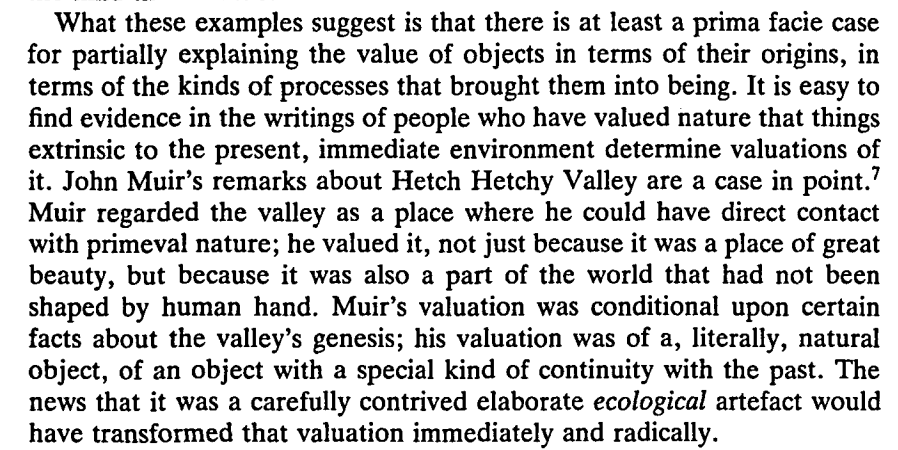
- the row of trees he values more when he thinks nature put them in a row
- nature writers who talk about untouched places (John Muir) THEREFORE
- Origins matter when it comes to nature.
_________________________
Restoration vs. Rewilding (next Wednesday)
- Restoration: Aim is to get back what was there before, returning to a past state
- Rewilding: A different aim, but sometimes the same methods
_________________________
_________________________
David Treuer, "Return the National Parks to the Tribes" (Atlantic Magazine May 2021).
- Connection to wildness debate
- Cronon--when we value wildness of nature, we are ignoring indigenous people who used to live on "wild" lands and were removed
- Let's turn our attention to them
Highlights from article below
What exactly is he proposing?
_________________________
Native Americans & US History
- First settlers saw US as wild and uninhabited but there were 5-15 million indigenous people here. (p. 32)
- Under the Indian Removal Act of 1830, Native Americans were driven west of the Mississippi.(p. 35)
- Reservations on barren land in the West were established in the mid 19th century. (p. 35)
- The Dawes Act (1887) gave parcels of reservation land to individual Native Americans and opened up the rest for purchase by white Americans. (p. 35)
- Native children were forced or coerced into attending boarding schools, where they were punished for speaking their own languages.
- Reservations are "sovereign nations" with their own laws, but don't have much commerce and are dependent on federal support (p. 34). The main commerce is "extractive industries, casino gambling, and tax-free cigarette sales" (p. 40)
- Tribal members don't want to lose their connection to their cultures. (p. 40, 41)
Native Americans & National Parks
- People think National Parks "offer Americans the thrill of looking back over their shoulder at a world without humans or technology. Many visit them to find something that exists outside or beyond us...." (p. 32)
- When National Parks were established, Native Americans were removed to make them more wild.
- Treaties involved in making the parks were negotiated in bad faith and/or violated. (p. 32)
- Theodore Roosevelt, who established a large number of national parks and other preserves, had little respect for Indians. (p. 37)
- Native Americans still live near many of the parks. (p. 36)
- The Park Sevice "has made it easier for Native people to harvest plants for traditional purposes" but they have to submit paperwork (p. 42)
- Some allow Native people to hunt and trap (p. 42) but some prohibit all hunting (p. 43) It's up to the park service, even though the National Parks were originally Native homelands.
Returning the Parks to Native Americans
- For Native Americans," there can be no better remedy for the theft of land than land. And for us, no lands are as spiritually significant as the national parks. They should be returned to us. Indians should tend--and protect and preserve--these favored gardens again." (p. 33)
- Native people need permanent, unencumbered access to our homelands--in order to strengthen us and our communities, and to undo some of the damage of the preceding centuries." (p. 43)
- "The preservation of these sublime places for future generations is of course crucially important, something Native Americans understand as deeply as anyone." (p. 43)
- The federal government allows overcrowding and habitat loss and some administrations reduce park staff and allow development on public land (2021) (p. 43)
- "All 85 million cares of national-park sites should be turned over to a consortium of federally recognized tribes in the United States." (p. 44)
- This would give Native Americans "unfettered access" and "restore dignity that was rightfully ours." (p. 44)
- "To be entrusted with the stewardship of America's most precious landscapes would be a deeply meaningful form of restitution." (p. 44)
- Native Americans are accustomed to administering reservations, so have the required administrative skills. (p. 44)
- "...the transfer should be subject to binding covenants guaranteeing a standard of conservation that is at least as stringent as what the park system forces today, so that the parks' ecological health would be preserved--and improved--long into the future." (p. 44)
- "The federal government should continue to offer some financial support for park maintenance, in order to keep fees low for visitors, and the tribe would continue to allow universal access to the parks in perpetuity." (p. 44)
- Precedents for this kind of transfer to indigenous people: Uluru and the Nothern Territory in Australia (transferred to Aboriginal peoples) Whanganui River in New Zealand (transferred to Maori). (p. 44)
_________________________
Debate
- Status Quo
- Stewardship under binding covenants (Treuer)
- Full, unlimited ownership -- should this be one position in debate?
- Judges group?